Three Types of Muscle Fibers in the Human Body and How to Optimize Them for Your Training Goals
When it comes to muscles, most people think in very simple terms: strong muscles or weak muscles. But the truth is, inside every muscle bundle are thousands of tiny muscle fibers — and not all fibers are the same.
Understanding the different types of muscle fibers in your body is the first step toward optimizing your training, avoiding misdirected workouts, and achieving higher performance — whether you’re a recreational athlete or a professional.
1. What types of muscle fibers are in the human body?
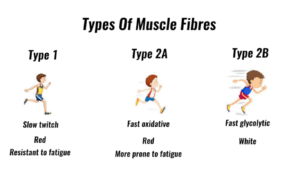
Illustration of the three main muscle fiber types: Type I, Type IIa, Type IIb. Source: TeachPE.com
The human body has three main types of muscle fibers, each with distinct physiological characteristics and roles in movement.
Type I fibers – slow-twitch fibers:
These fibers contract slowly, are energy-efficient, and extremely fatigue-resistant. They contain a high density of mitochondria and are supplied by a rich capillary network, allowing them to sustain prolonged activity. If you enjoy long-distance running, cycling, swimming, or endurance sports, this is the fiber type you need to develop.
Type IIa fibers – intermediate fast-twitch fibers (fast oxidative):
Faster and stronger than slow-twitch fibers, yet still relatively resistant to fatigue. Type IIa fibers are highly “adaptable” — they can be trained toward strength or endurance depending on the training stimulus. This makes them ideal for athletes in combat sports, CrossFit, or mixed-modal training.
Type IIx fibers – pure fast-twitch power fibers (fast glycolytic):
The fastest and strongest fibers, but also the ones that fatigue the quickest. These fibers are crucial for weightlifters, jumpers, and sprinters. To use them effectively, adequate recovery time and a well-developed nervous system are essential.
2. Why does each person have a different muscle fiber ratio?
The first and most significant factor is genetics. Some people are born with 60–70% slow-twitch fibers — naturally suited for endurance. Others are more fast-twitch dominant — they build muscle faster, jump higher, and produce explosive power more easily.
However, long-term training can partially reshape muscle fiber characteristics. For example, individuals with a higher proportion of Type IIx fibers who consistently train endurance may gradually shift those fibers toward Type IIa — becoming more versatile and fatigue-resistant.
One crucial point to remember: the body cannot create entirely new muscle fibers. But you can activate fibers that are relatively “dormant,” and you can train already active fibers to reach their maximum potential.
It’s also important to note that muscle fiber distribution is not uniform across the body. The thigh muscles may lean toward slow-twitch fibers, while the shoulders or arms may be more fast-twitch dominant — a highly individualized trait.
3. How can you tell which muscle fiber type you have more of?
The most accurate method is a muscle biopsy — taking a small muscle tissue sample and analyzing it under a microscope. However, this method is expensive, invasive, and impractical for most people.
Some athletes use the 80% 1RM test as an estimation tool:
If you can lift 80% of your one-rep max for more than 12 reps → you likely lean toward slow-twitch fibers.
If you can only manage fewer than 6 reps → you may be more fast-twitch dominant.
That said, these results are only approximate. What matters far more is this: regardless of your natural predisposition, you can still train, adapt, and improve.
4. Muscle fiber traits don’t determine everything
Let’s say you have a high proportion of fast-twitch fibers but love running marathons. So what?
Fast-twitch fibers still play a strategic role — during surges, hill climbs, and finishing sprints. They are not “useless,” even when glycogen is depleted. More importantly, athletic performance is not determined by muscle fibers alone. It is the combined effect of the cardiovascular system, respiratory system, nervous system — along with technique, strategy, and mindset.
So don’t obsess over your muscle fiber type. Train consistently, intelligently, and in alignment with your goals — progress will follow. Your body will adapt more intelligently than you might expect.
5. Conclusion
Understanding muscle fiber types is an important step if you want to train with intention. But they are not fixed boundaries that decide whether you are strong or weak, fast or slow. Persistence, effort, and consistency are what truly separate those who succeed in training from the rest.
You don’t need to know exactly which muscle fiber type you have. You only need to know who you want to become — and take action toward that goal, every single day.